Agent-Built · Part 3 of 4
Repos as Experts
How posts get made here: an executable skills pipeline, and an authority system where the repo a post describes is consulted as its domain expert.
On this page
Part 1 explained why an agent can’t ship a broken page here, and part 2 showed the vocabulary posts are written in. This part is about the harder problem: not can the page build, but is the post any good, and is it true? An agent writing about a codebase it half-remembers will produce plausible, wrong prose all day. This site’s answer has two parts: the editorial process is a set of executable files, and every technical post names another repository as its domain expert, a repo that gets consulted, like a colleague, about the post describing its own work.
The pipeline is a set of files#
Editorial quality here isn’t a habit; it’s seven procedure files, committed under
.claude/skills/, that an agent invokes and follows. Habits don’t survive a worker with no
memory; files do.
Each skill guards something specific. write-post owns the shape of a draft and ends with a
mandatory visual pass: its own rule says a technical post typically yields two to four visuals,
and “zero means the pass was skipped, not that nothing qualified.” create-hero makes the
author write the hero image’s alt text first: if you can’t write the sentence, the idea
isn’t concrete enough to draw. review-post runs the automated gates plus a human-judgment
read-through and outputs a findings list rather than silently rewriting anything. And
publish-post is the only place draft: false ever gets set; it ends by verifying the live URL,
the listings, and the RSS feed on the deployed site, not by trusting the push.
Two supporting skills sit off the main chain: create-series (registry entry first, post
second; the build fails on an unregistered series) and wrapup, a whole-site audit for
batches, built around grep sweeps where every hit is either a contract violation or must
justify itself.
Every post names its expert#
The frontmatter of every technical post here carries an authority field: the path to the
repository that owns that post’s domain facts. For the three posts about upscaling Sierra
adventure-game backgrounds, that is the SCI rendering repo. For the retirement-simulation posts,
the simulator. For this series, the blog’s own repo.
The contract, written into write-post and shared by the other skills, says the authority repo
owns “what the story actually is, what matters and what is misleading”: behavior, terminology,
data meaning, technical claims, evidence, caveats, and the semantics of every visual. The blog
owns the artifact: structure, prose, MDX, visual design, accessibility.
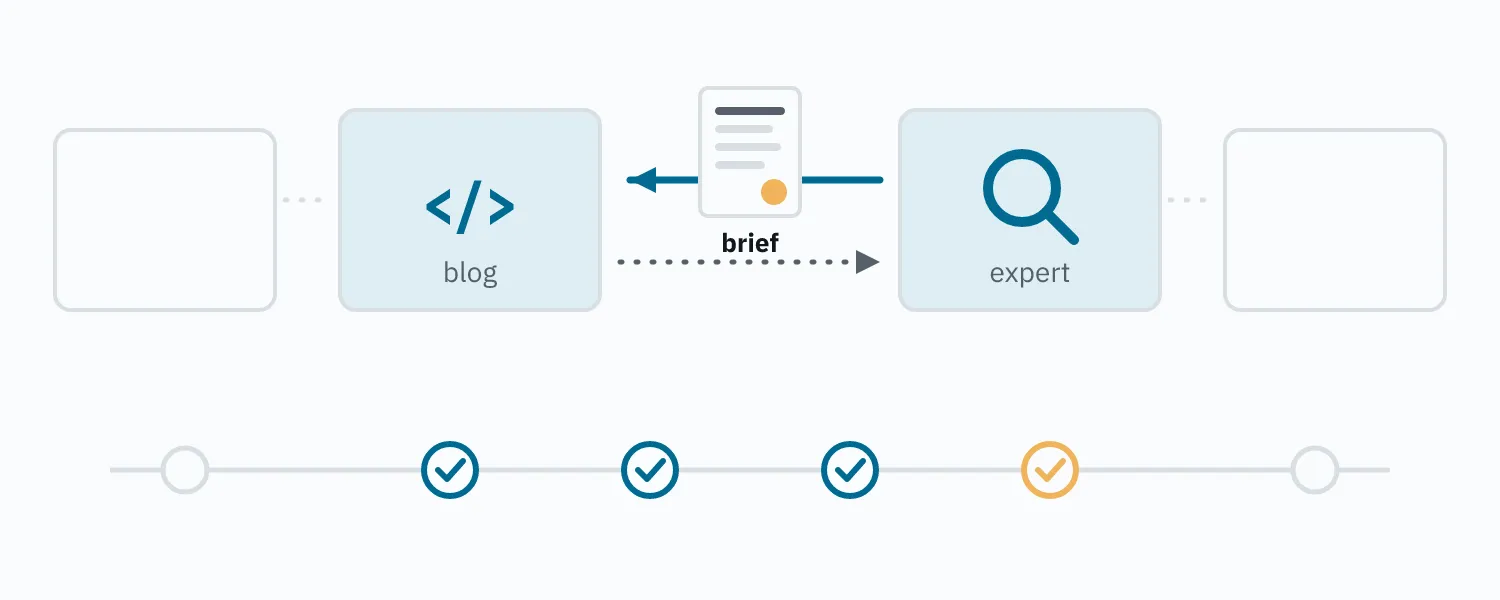
Mechanically, an agent is dispatched into the authority repo, where it reads that repo’s own instructions, source, tests, and data, and makes domain decisions. The budget is strict: two calls per post.
The first call produces a domain brief: the strongest version of the story, the claims worth
making with their evidence, corrections to the author’s outline, terminology, caveats, and, for
every proposed visual, the exact data and semantics needed to draw it correctly. The brief is
committed to the post’s directory at research/brief.md, in public, and everything downstream
works from it instead of re-asking. The second call validates the finished draft against what the
expert previously asserted. A targeted extra question is allowed only when the brief genuinely
cannot answer it, and the answer gets appended to the brief.
What an expert actually said#
The system earns its keep when the expert pushes back. The first retrofitted brief on this site, for the post on AGI-UP as a reference renderer, came back with eight numbered factual corrections to an already-published post. It found the post’s pipeline diagram had two stages in the wrong order (“The repo says the opposite… the seal runs before gap closure”). It found the ending confidently predicted a next step that never happened, and named what actually happened instead. It flagged one of the author’s own claims as unverifiable and said to keep it only if the author personally vouches. It even caught the authority repo contradicting itself (two configs, two different thresholds) and told the blog to disclose the discrepancy rather than paper over it.
And asked to propose new visuals, it declined:
None earn their place… the one dataset that would genuinely add depth… no longer exists in the repo.
An expert that says no is the strongest evidence the role is real.
What the system does not guarantee#
The limits, in order of sharpness:
- The expert can be wrong. Its own repo disagreed with itself over a threshold. The contract buys an accountable, evidence-cited process, not truth.
- Briefs go stale. The corrected post’s ending was true when written and false months later. A brief is a snapshot with an append rule.
- Nothing enforces brief quality. A lazy investigation gives a thin brief and a green build. The backstops are the validation pass and the fact that briefs are public.
One design seam worth noticing: authority is optional in the frontmatter schema but required by
the writing skill. That split is deliberate. The Zod schema enforces what a machine can check:
lengths, registries, date logic. The skills enforce what only procedure can check. The build
gates from part 1 keep an agent from shipping a broken page; the
process gates here keep it from shipping a fluent, well-formed, wrong one.
This post, as evidence#
This post’s own authority is the blog repository. That isn’t a joke; it’s the rule applied
uniformly: for a post about the pipeline, the pipeline’s repo is the correct expert, the same
way the SCI renderer was for the upscaling posts. The investigation pass for this post ran like
any other: an agent was dispatched into the repo, read the seven skills and the one existing
retrofit brief, and returned the domain brief this post was then written from. It is committed at
research/brief.md in this post’s directory, where you can check whether the expert and the
prose agree. When the authority and the artifact are the same repo, the division of labour is
procedural rather than physical (two passes and a committed brief instead of two codebases), but
the paper trail is the same.
That’s the whole system, and this series is its output: contracts that make broken states unbuildable, a vocabulary an agent can wield without inventing anything, and an editorial process that treats repositories as colleagues with domain knowledge worth consulting. It’s all in the repo.