Strudel Bench · Part 4 of 5
Mixing as a scene
A mix is where things are, not how loud they are: one hall, a position each, levels by role, a played feel, and a tool that measures whether it worked.
On this page
Here is the peak of a thirteen-part orchestral section, twice. The notes are identical. Nothing was added or removed. Between the two, every part was given a place.
Four bars each, in stereo. Same notes, same instruments, same tempo.
Measured before, the loudest thing in that climax was the impact hit, five decibels under the whole mix. The choir was a decibel louder than the piano theme it was supposed to sit behind, and shared the midrange with the organ. The timpani pulse was thirty decibels under the mix and the glockenspiel doubling was forty, which is to say neither could be heard at all. Nothing had a position, and the parts were spread over five separate reverbs.
This post is about what “give every part a place” means when the tool has no faders, only a language: the handful of keys strudel-bench added for mixing, the perception each one leans on, and the measurement that says whether it worked. The earlier posts covered the language, the words and the editor; this one is about the newest and least finished part of the system.
What a mix is, if it is not volume#
A mixing engineer’s first move is not the fader. It is deciding where each thing is: how far forward, how far left, how much of the room it sits in, and which two things are fighting for the same air. Volume falls out of those decisions.
Perception gives you a few handles for “where”:
- Level tells you how far away, but only roughly, because a quiet close sound and a loud distant one can arrive at the same loudness.
- Brightness tells you distance more reliably: air and rooms swallow high frequencies, so a dull version of a sound reads as farther away than a bright one at the same level.
- The reverb tail, and how the direct sound sits in front of it, tells you the size of the room and where in it the source is. If the first reflections arrive a few tens of milliseconds after the direct sound, the ear localises the direct sound and folds the reflections into it. That is the precedence effect, and it is why a reverb with a short silent head in front of it keeps a part in place while a reverb with none smears it.
- Masking: a louder sound at a nearby frequency raises the threshold at which a quieter one can be heard at all. Two parts in the same band at the same time do not add; one of them disappears.
- Timing: a line whose notes land exactly on the grid reads as a machine. One whose notes lean late and early together, in a shape that repeats, reads as played.
strudel-bench encodes each of those as a key you can write in a part or a section. None of it is a fader. Here they are.
One room#
Before the pass, arrival’s parts were in five different reverbs, because each kind of part sets its
own reverb size from its space axis, and superdough keeps one reverb per bus. Put two parts that
want different reverbs on one bus and the engine rebuilds the impulse response under whichever note
arrives next. The piece’s own notes record that happening under the piano, and blame it for the
piano’s pop.
The fix is a room on the song:
song({ bpm: 64, key: 'D:minor', seed: 41, kit: 'RolandTR808', packs: ['rooms'],
       room: { ir: 'hall', size: 3.2, damping: 4500 } }, [
With a room set, every part in the section shares one convolver, and each part’s space value stops
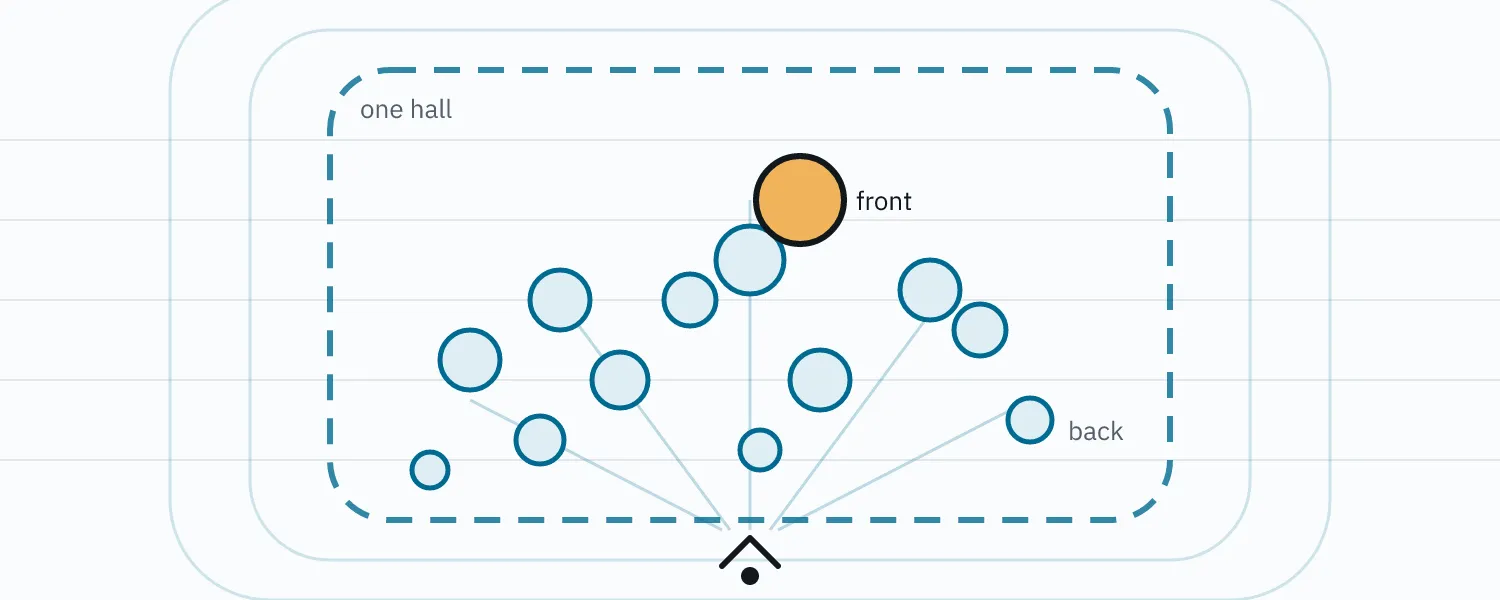
meaning “which reverb” and becomes “how much of it”: its send. Thirteen parts, one hall, each with
its own amount of it.
The ir is a generated impulse response, not a recording. A small script builds a shoebox room from
its dimensions and absorption, places the mirror-image reflections as taps, then appends a seeded
noise tail that darkens as it decays. Three ship with the repo: a small room with an 8 ms silent
head, a plate with 15 ms, and a hall with 30 ms and a 3.2 second decay. The silent head is the
pre-delay, and it is baked into the file because the engine has no pre-delay control of its own; a
song can shorten it by starting the impulse partway in.
Here is the difference one hall makes on a small demo section: five parts, first in separate reverbs with no positions, then under one hall with a position each.
Four bars each, in stereo. The second is the same material with a room on the section, each part's space as its send, and a position each.
The perceptual claim is a modest one. Sources that share a room signature are grouped as being in the same place; sources that each carry a different one read as a collage. Mixing engineers have worked that way for decades, on one main reverb. Here it is one key.
A position, and then a width#
position runs from -1 (left) to 1 (right) and shifts every note’s pan by half of it. It is
deliberately separate from width, which the language already had. Width is how much of the field a
part occupies; on most parts it is a slow pan sweep, on wide pads a mirrored copy in the other ear.
Position is where the centre of that is. Set both and the sweep moves around the position, and a
drum kit’s per-voice spread moves as one block.
The measurement taught me two things about this. The rendered pan of a wet part sits near the centre whatever its position says, because the hall’s stereo return dominates its energy: the bowed vibraphone is written at -.35, its notes carry that pan, and the measured stem reads as almost centred. And the piano sample is right-heavy on its own, reading at .74 with no position at all. What the ear gets is the position plus the sample plus the room, and the number in the file is only the first of those.
The low end stays centred. Localisation below about a hundred hertz is poor, stereo bass wastes headroom, and it falls apart on a mono speaker, so the measurement’s flat-stage rule exempts the drums and the bass from ever needing a position.
| Part | Position | Depth | dB under the mix |
|---|---|---|---|
| piano theme | +0.10 | 0.41 | -7.5 |
| organ pedal | 0 | 0.43 | -9.9 |
| impact hit | 0 | 0.46 | -12.0 |
| loud organ | 0 | 0.76 | -12.1 |
| recorders | -0.20 | 0.77 | -12.9 |
| handchimes | +0.35 | 0.66 | -13.1 |
| vibraphone doubling | -0.45 | 0.65 | -13.6 |
| tubular bells | +0.35 | 0.71 | -13.8 |
| harp | -0.30 | 0.74 | -15.9 |
| bowed strings | -0.15 | 0.81 | -15.9 |
| choir | +0.30 | 0.85 | -18.7 |
| timpani pulse | 0 | 0.58 | -20.9 |
| bowed vibraphone | -0.35 | 0.90 | -22.2 |
Depth, in words#
Depth is the axis the fader cannot do alone. The vocabulary got four words for it: closer and
forward raise brightness, lower space and add a little weight; farther and background do the
reverse. They move three axes at once, gently, because that is what distance does to a sound: it gets
duller, wetter and thinner together. The measurement’s depth number is built from the same three
things, level, high-frequency share and reverb tail, and the tool insists you read it with its three
inputs, because a high depth from level alone is a quiet part, not a distant one.
The choir is the worked example. Before the pass it was as loud as the piano theme and sharing the
midrange with the organ. After: level cut, farther applied, brightness down from .6 to .4, sent
fully into the hall, and placed behind and to the right.
Four bars each, the part on its own. The second is much quieter on purpose: at its new level it sits nineteen decibels under the mix.
The level cut is not what moved the masking. The organ and choir shared the mids at .72 on the measurement’s scale before, and .45 after, comfortably under its .6 warning line. The ten decibel level cut did nothing to that score, because the masking measure is level-independent by construction: it asks where two parts’ energy sits and whether they sound at the same time, not how loud either is. What moved it was the choir getting darker. Its centroid fell from 1376 Hz to 877 Hz, out of the organ’s band. A quieter part in the same band is still in the way; a darker one is not.
Levels by role, not by feel#
Once every part has a place, the fader is the last thing you touch, and the project writes down what it should do. Name each part’s role and give it a band under the mix: a foreground part six to twelve decibels under, support ten to eighteen, background sixteen to twenty-six, with the kick and bass as foundation. Below thirty is inaudible: cut it or raise it, never leave it. These are the author’s defaults, marked as heuristics in the code, not laws of hearing.
| Part | Before | After |
|---|---|---|
| piano theme | -9.6 | -7.5 |
| organ pedal | -11.1 | -9.9 |
| impact hit | -5.0 | -12.0 |
| loud organ | -13.3 | -12.1 |
| recorders | -14.1 | -12.9 |
| handchimes | -15.4 | -13.1 |
| doubling (glockenspiel, then vibraphone) | -40.4 | -13.6 |
| tubular bells | -25.8 | -13.8 |
| harp | -22.2 | -15.9 |
| bowed strings | -18.7 | -15.9 |
| choir | -8.6 | -18.7 |
| timpani pulse | -30.2 | -20.9 |
| bowed vibraphone | -22.8 | -22.2 |
The timpani pulse was thirty decibels under the mix at a level of 1, and the top of the level range, 2, only brought it to twenty-one. The sample is quiet. Meanwhile, by the score’s own per-event gain, the triangle in that same pulse is the loudest voice in the finale by a wide margin. The number the language exposes and the number the render reports disagree, and only one of them is what you hear.
The doubling voice came up twenty-seven decibels by having its level lowered, from .45 to .2, because it stopped being a glockenspiel and became a vibraphone. The glockenspiel sample was too quiet to place at any level; a vibraphone at the same register is loud. Levels are per sample, not per intention, and no amount of reasoning about the file would have found that. A render did.
Making room: the sidechain#
When a bass and a kick want the same air, you can dip the bass for the instant the kick hits and let it recover. The transient gets through, the sustain comes back, and the two never sound at the same moment in the band that matters.
bass: { ...sub, duck: 'drums', duckDepth: .5, duckAttack: .12 },
pad:  { ...bed, duck: 'drums', duckDepth: .6, duckAttack: .25 },
duck names another part in the section. Its hits are pointed at this part’s bus as a sidechain,
the depth sets how far the dip goes, and the recovery time sets whether it breathes or pumps. It is
superdough’s own ducking, wired up by name. Before that existed the pad layer faked it, dipping a
hard-driven pad’s gain once per chord, and the fake is still there as the fallback when no source is
named.
Four bars each. In the second, the bass and the pad dip under every kick and recover.
Arrival ducks nothing. A sixty-four beat-per-minute score with a timpani pulse has no kick to make room for. The industrial track in the same repository ducks its bass and its sub pad, and still fails the tool’s headroom check, because its kit is distorted and the distortion happens after the gain: a distorted part peaks at full scale whatever its level says. There is no master limiter, and the tool says so.
A played feel, not dice#
The language has always had an organicness axis: above its midpoint it nudges every hit by a fresh
random amount and scales its gain by another. It sounds like what it is. Independent per-hit jitter
does not sound like a person; it sounds like a machine imitating one, because a player’s timing is
not noise. Neighbouring notes lean together. The lean is different at different points in the bar. And
it is broadly the same on the next play, because it comes from the player’s body and the phrase, not
from a coin.
humanize is the replacement, and it is material rather than an axis:
humanize: { timingMs: 12, velocity: .1, correlation: 'phrase' }Three seeded curves, evaluated at each note’s time: a slow wave over the correlation span (a bar, a phrase, or a count of bars), a fixed lean for each beat position inside the bar, and a small residual. Their sum moves timing, gain and note length together, and because it is seeded it is the same on every play and in every render.
The timing is late-only, and the reason is engineering rather than perception: a note moved earlier than its grid point can fall before the start of a render and be dropped, and renders, the checker and live playback must agree.
Hear the same marimba line and rim three ways: dead on the grid, with dice, and played.
Four bars each. The middle one uses the older axis at its maximum; the last uses humanize with a phrase-length correlation on the marimba and a bar-length one on the rim.
And the piano theme itself, alone, before and after. The notes are the same. The second one is closer, a little to the right, has a phrase-shaped velocity line, and leans.
Four bars each. Before: dice-per-hit organicness, no position, a shared default reverb. After: humanize, a velocity line, position .1, sent into the hall.
One more key rounds out the set: a compressor per part, for the rare part that is spiky enough to
need it. The tubular bells strike twice a bar with a crest factor over nine, so they got one at a
threshold of -18 dB and a ratio of 3. The engine builds a compressor node per hit, so the linter
warns if you put one on anything dense.
Measuring whether it worked#
None of the above would be worth much if the only judge were my ear on my speakers. The measure command renders a section’s mix, then renders each part alone, and prints a table: each part’s level under the mix, its depth with the three inputs beside it, its measured pan, its peak, and then the masking pairs, every pair of parts that shares a band at the same time, sorted by how badly. A second linter reads that file and applies rules with written thresholds: no headroom, an inaudible part, a dominant part, a flat stage where three or more parts all sit centre, two parts sharing the low band or the mids past a line, no depth contrast.
Before the pass, arrival’s climax drew five warnings: two inaudible parts and three pairs sharing the mids. After it: clean. The mix’s peak fell from .92 to .39, because the impact had been the peak, and nothing clipped in either version.
Every number above is a proxy. The masking score is three fixed bands and a co-occurrence count, not a critical-band model; it is symmetric and level-independent, where real masking is neither. The level column is unweighted RMS, not loudness, so a low pulse at twenty-one decibels under is perceptually further down than a chime would be at the same number. Depth is a weighted sum with hand-picked weights. Pan reads the rendered stem, room included. There is no per-part EQ beyond one tilt, no true pre-delay control, no master bus. It measures four bars of a section by default.
What it does do is turn a mix into a described object: a table of where things are and what is in the way, with a verdict per rule. That is a thing a person can argue with, and it is a thing a program that cannot hear can act on. The whole of the piece it was built on got its second draft that way, and what the pass missed, it missed because it was not in the section that was measured. A tool looks where it is pointed.